

Heavy-Duty Zip Ties in Australia: What to Buy and Where to Get Them
Heavy-Duty Zip Ties in Australia: What to Buy and Where to Get Them
You already know you need zip ties. The question is which ones — because grabbing the wrong packet and finding they snap under load, crack in the sun, or come in the wrong length is an expensive lesson on a large project.
This guide is for anyone in Australia sourcing heavy-duty zip ties for trade, construction, marine, agricultural, or outdoor use. It covers what actually makes a zip tie heavy-duty, which type suits your application, what size and strength you need, and where to buy in bulk without overpaying.
What Makes a Zip Tie "Heavy-Duty"?
Not every zip tie that says "heavy-duty" on the packet is built the same way. The term gets applied loosely. What you are actually evaluating is three things:
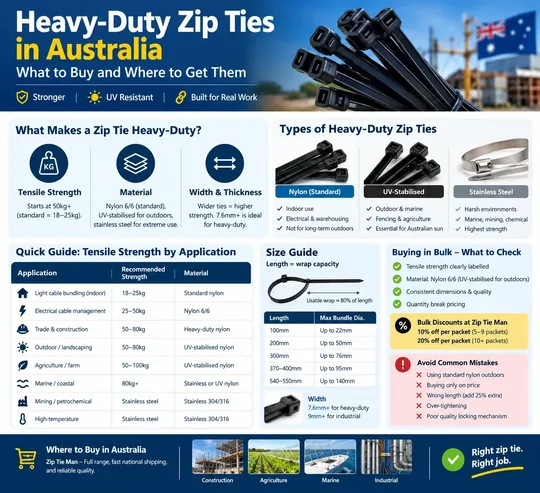
Tensile strength. This is the force the zip tie can withstand before the locking mechanism or the tie body fails. Standard zip ties run from around 18kg to 25kg tensile strength. Heavy-duty zip ties start at 50kg and go up to 120kg or more depending on the width and material. For serious load-bearing or bundling applications, 80kg+ is the range to target.
Material. Most zip ties are nylon — specifically Nylon 6/6, which is the standard polymer used in electrical-grade fasteners. Heavy-duty variants use a thicker nylon cross-section. For outdoor or UV-exposed applications, you need UV-stabilised nylon (often called UV-resistant or UV black, because the UV stabiliser turns the tie dark). Untreated nylon turns brittle in Australian sun within months.
Width and thickness. Wider body = more surface contact = higher tensile rating. A 4.8mm wide tie is a standard tie. A 7.6mm or 9mm wide tie is the heavy-duty format. Width and tensile strength are directly related — always cross-reference both when comparing products.
Types of Heavy-Duty Zip Ties: Which One Do You Need?
Nylon Heavy-Duty Zip Ties (Standard)
The most common heavy-duty option. Nylon 6/6, thick body, high tensile rating, suitable for indoor applications, protected wiring, bundling in dry or low-humidity environments.
Best for: Electrical cable management indoors, warehousing and racking, manufacturing, temporary fastening on construction sites (non-exposed).
Not ideal for: Long-term outdoor exposure, marine environments, high-temperature applications, chemical exposure.
UV-Stabilised Zip Ties
Made from UV-stabilised nylon — the key difference being an additive that resists breakdown from ultraviolet radiation. Typically black in colour (the carbon black additive provides UV resistance). In Australia's UV environment, this is the only appropriate zip tie for any permanent or semi-permanent outdoor application.
Best for: Fencing, landscaping, outdoor cable management, agricultural infrastructure, outdoor signage, building facades, any exposed application.
Not ideal for: Applications requiring specific colour coding, food-safe or medical environments.
Important note for Australian buyers: Australia has one of the highest UV indices in the world. A standard white or natural nylon zip tie used outdoors will typically become brittle and fail within 3 to 12 months depending on the location and sun exposure. UV-stabilised zip ties are not optional for outdoor Australian applications — they are essential.
Stainless Steel Zip Ties
Stainless steel cable ties are the highest-performance option available for extreme environments. They offer tensile strength well above nylon alternatives, complete resistance to UV degradation, and resistance to corrosion, chemicals, and temperature extremes.
Best for: Marine applications, coastal infrastructure, petrochemical and mining environments, high-temperature environments (engine bays, industrial plant), any application where long-term reliability in harsh conditions is non-negotiable.
Consideration: Stainless steel zip ties require a different tool for installation and cutting. They are significantly more expensive than nylon. They are the right choice when failure is not an option.
Zip Tie Tensile Strength Guide by Application
| Application | Recommended Tensile Strength | Material |
|---|---|---|
| Light cable bundling indoors | 18–25kg | Standard nylon |
| Electrical cable management | 25–50kg | Nylon 6/6 |
| Trade and construction bundling | 50–80kg | Heavy-duty nylon |
| Outdoor fencing / landscaping | 50–80kg | UV-stabilised nylon |
| Agricultural / farm infrastructure | 50–100kg | UV-stabilised nylon |
| Marine / coastal applications | 80kg+ or stainless steel | Stainless or UV nylon |
| Industrial / mining / petrochemical | Stainless steel | Stainless 304 or 316 |
| High-temperature environments | Stainless steel | Stainless 304 or 316 |
Zip Tie Sizes: Getting the Length and Width Right
Length determines how large a bundle you can wrap. The usable wrap circumference is approximately 80% of the total tie length.
| Tie Length | Approx. Max Bundle Diameter | Typical Use |
|---|---|---|
| 100mm | Up to 22mm | Thin cable bundles, light use |
| 200mm | Up to 50mm | Standard cable management |
| 300mm | Up to 76mm | Mid-sized bundles, conduit |
| 370–400mm | Up to 95mm | Large bundles, pipes |
| 540–550mm | Up to 140mm | Very large bundles, structural |
Width determines tensile strength and locking reliability. For heavy-duty applications, 7.6mm is the practical minimum. 9mm and above are industrial-grade.
Rule of thumb: Buy longer than you think you need. Trimming excess tail is simple. Running short and needing to double-up zip ties to extend reach wastes product and time.
Buying Zip Ties in Bulk in Australia: What to Look For
Buying in bulk makes sense for any project running more than a few hundred ties. The cost-per-tie drops significantly at volume, and having excess on hand beats running short mid-job.
What to check before buying:
- Tensile strength labelled per packet — not just the tie width. Some suppliers list width and not strength.
- Material specification — Nylon 6/6 for standard. Confirm UV stabilisation is present for outdoor ties, not just black colouring (carbon black for aesthetics only does not provide UV resistance).
- Consistent dimensions — reject rate goes up with off-brand product where tolerances vary per production run.
- Quantity break pricing — reputable Australian suppliers offer tiered pricing at 5+ packets or 10+ packets that meaningfully reduces per-unit cost.
Zip Tie Man offers automatic quantity discounts across their range — 10% off per packet at 5–9 packets, and 20% off per packet at 10+ packets, applied at checkout without a code. For large project procurement, this is a practical starting point for Australian trade buyers.
Common Zip Tie Mistakes on Large Projects
Using standard nylon outdoors. Standard nylon goes brittle in UV exposure. Always UV-stabilised for outdoor Australian conditions.
Buying purely on price per tie. A zip tie that fails requires replacement labour on top of product cost. The cheapest ties are rarely the cheapest outcome.
Buying the wrong length. Measure the bundle circumference first. Add 25% minimum to account for the locking head and tail.
Over-tightening. Overtightening beyond the recommended load crushes cable insulation. Use the appropriate tensile strength for the application, not the maximum available.
Not checking the locking mechanism. Cheap zip ties have poorly formed pawl and ratchet mechanisms that slip under vibration or load. Check for positive engagement when locking.
Where to Buy Heavy-Duty Zip Ties in Australia
For Australian buyers, sourcing locally means faster delivery, no customs delays, and supplier accountability under Australian Consumer Law.
Zip Tie Man — Australian supplier with a full range including heavy-duty nylon, UV-stabilised, stainless steel, and specialty cable ties. Ships nationally. Quantity discounts apply automatically.
For specialised stainless steel or large-format zip ties, a dedicated cable tie supplier outperforms general trade merchants on range and volume pricing.
Frequently Asked Questions
What tensile strength do I need for heavy-duty zip ties in Australia?
For most trade and construction applications, a minimum of 50kg tensile strength with a 7.6mm+ wide body is appropriate. For outdoor or high-stress applications, 80kg+ is recommended. Stainless steel ties are the choice for marine, mining, or high-temperature environments.
Are black zip ties UV resistant?
Not automatically. Some black zip ties are coloured for identification only and do not contain UV stabiliser. Look for "UV-stabilised" or "UV-resistant" explicitly stated in the product specification, not just black colouring.
What size zip ties do I need for large cable bundles?
For bundles over 75mm in diameter, use 400mm+ length ties in 9mm width. For bundles over 100mm, consider 540mm+ ties or zip tie extensions.
How many zip ties do I need for a large project?
Calculate: number of fastening points × 1.15 (add 15% wastage and mistakes). Buy the next packet quantity up to hit a bulk discount tier — the saving typically exceeds the cost of the extra stock.