

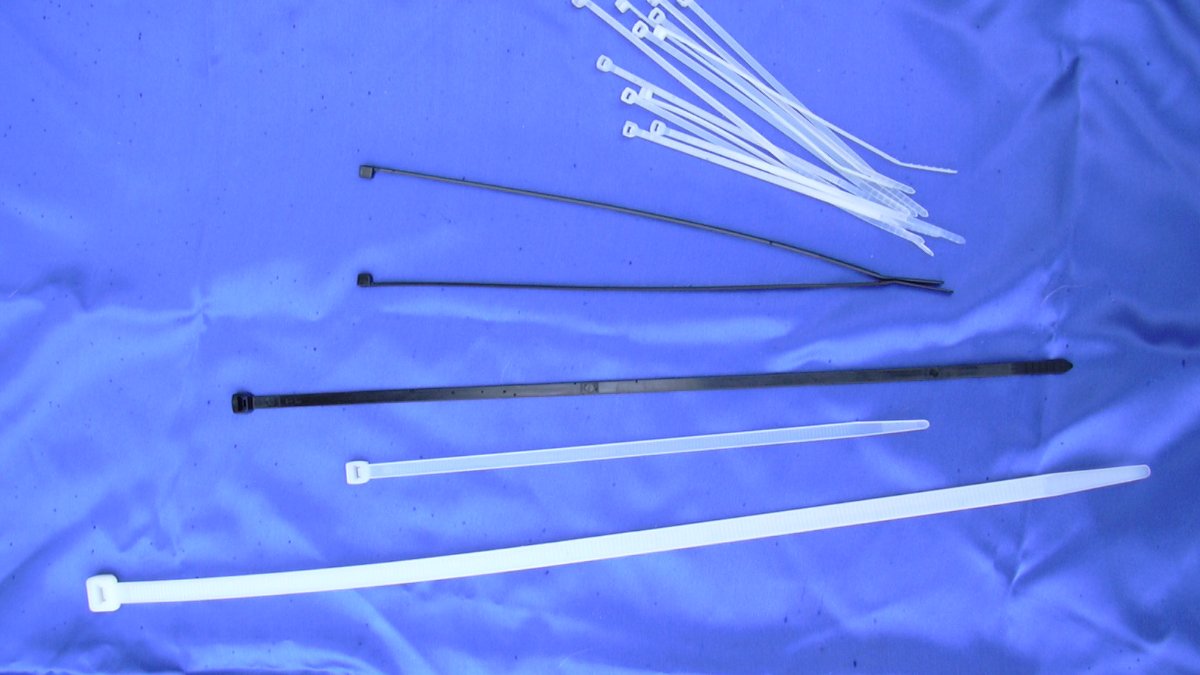
Zip tie sizes are written as width x length, for example 4.8 x 200mm. The width decides how strong the tie is. The length decides how big a bundle it can go around. Get both right and the tie holds for years; get either wrong and it snaps, slips or will not close.
This guide charts every size we stock, with inch equivalents and breaking strains, and shows how to measure a bundle before you buy.
How zip ties are measured
- Width is measured across the strap, in millimetres. Our nylon ties run from 2.5mm to 12.7mm.
- Length is measured from the end of the head to the tip of the tail, laid flat. Ours run from 100mm to 1220mm.
- Breaking strain is the load, in kilograms, at which the tie snaps. It rises with width, not length.
Zip tie size chart
All sizes below are nylon 66 ties we stock. Inch figures are rounded to the nearest half inch.
| Width | Breaking strain | Lengths (mm) | Lengths (inches, approx.) | Colours |
|---|---|---|---|---|
| 2.5mm | 8kg | 100, 150, 200 | 4, 6, 8 | Black, white, colours (200mm) |
| 3.6mm | 18kg | 150, 200, 300 | 6, 8, 12 | Black, white |
| 4.8mm | 22kg | 200, 250, 300, 370, 450 | 8, 10, 12, 14.5, 17.5 | Black; white to 370mm; colours at 200 and 300mm |
| 7.6mm | 55kg | 200, 300, 370, 450, 530, 750 | 8, 12, 14.5, 17.5, 21, 29.5 | Black; white at 300 and 370mm; dark blue at 200mm |
| 9mm | 80kg | 530, 630, 780, 920, 1220 | 21, 25, 30.5, 36, 48 | Black; white at 530mm |
| 12.6mm and 12.7mm | See pack | 230, 380, 560, 730 | 9, 15, 22, 28.5 | Black |
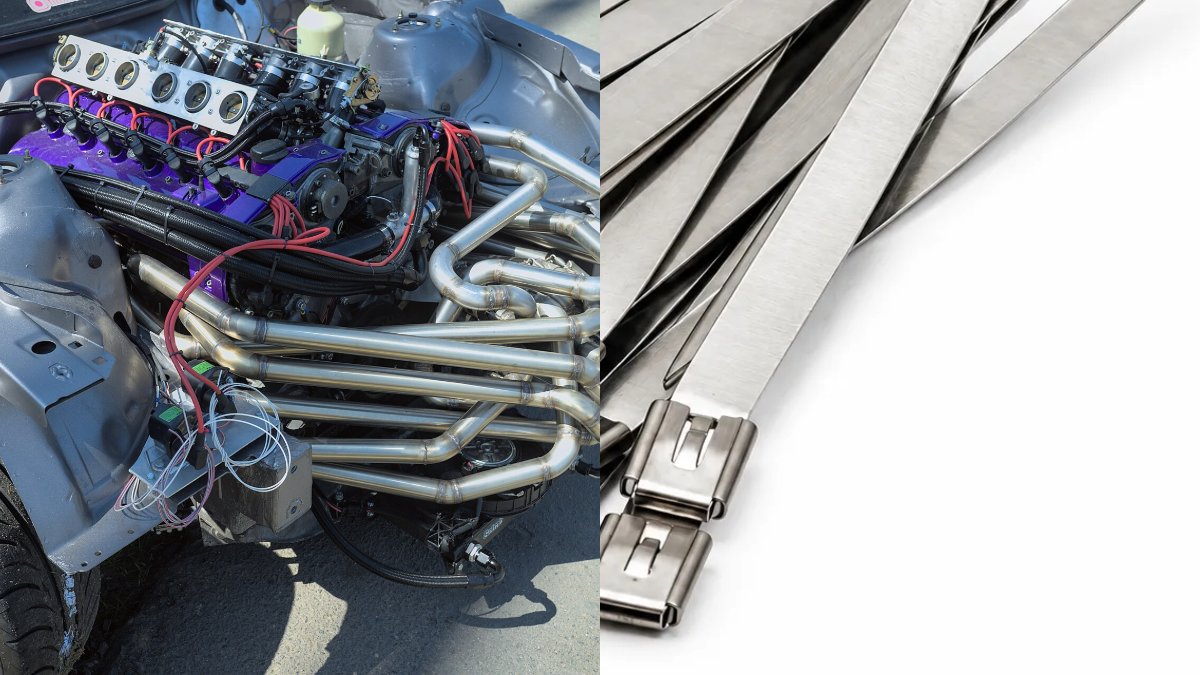
Stainless steel ties are sized differently: 4.6mm wide in 200, 300, 350 and 500mm, and 7.8mm wide in 250, 350 and 500mm. See the stainless steel range.
Step 1: pick the width for the load
Start with what the tie has to hold, then choose a width whose breaking strain sits well above it. Breaking strain is the point of failure, not a safe working load, so leave a margin.
- 2.5mm (8kg): single leads, patch leads, tags and small looms where a thin strap looks neat.
- 3.6mm (18kg): light household jobs, garden ties and small looms.
- 4.8mm (22kg): the all-round width for wiring, conduit, fencing mesh and general repairs.
- 7.6mm (55kg): heavy duty zip ties for welding leads, steel offcuts, pipe and signs.
- 9mm (80kg): oversized bundles, heavy hose and pipe.
- 12.6 to 12.7mm: the widest strap, for fat looms and hydraulic hose bundles.
Wider straps also spread the load, so they are kinder to soft hose and sheathing. For how breaking strain works in practice, see how strong zip ties are.
Step 2: pick the length for the bundle
The tie has to go right around the bundle and leave enough tail to grip and pull tight. The easiest way to check:
- Wrap a piece of string once around the bundle where the tie will sit.
- Measure the string. That is the distance the strap has to cover.
- Choose a tie longer than that, with a few centimetres spare for the head and a tail to pull on.
Do not over-buy on length. A tie far longer than the bundle wastes strap and leaves a big offcut to trim. If no single tie is long enough, step up to the 9mm range, which goes to 1220mm, rather than joining zip ties together.
Step 3: pick the colour and material for the place
- Outdoors or in the sun: black, which is UV stabilised.
- Where the finish shows: white, which carries a UL94 V2 flammability rating.
- For coding: coloured zip ties, the same strength as black and white of the same width.
- Near heat, salt or chemicals: stainless steel, rated to approximately 538°C.
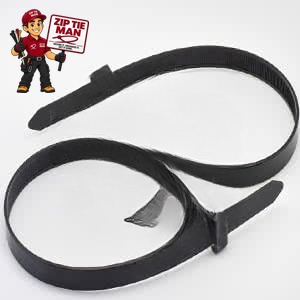
- If you will reopen the bundle: releasable zip ties, 7.6mm wide at 55kg.
Common sizing mistakes
- Buying length for strength. A longer tie is not a stronger tie. If a 4.8mm tie snaps, go wider, not longer.
- Using a thin tie on soft hose. A 2.5mm strap can bite into rubber or silicone. A wider strap spreads the pressure.
- Leaving no tail. If the tie only just reaches, you cannot pull it tight. Buy the next length up.
- Clear or white ties in full sun for years. Black UV stabilised ties are the pick for long outdoor jobs.
- Ignoring heat. Near exhausts and engines, any nylon tie will soften. Use stainless steel.
How to measure a zip tie you already have
Lay it flat, measure across the strap for the width, and from the end of the head to the tip of the tail for the length. If the tie has been cut, measure a new one from the same packet, or match the width and order the length you need from the chart above.
Sizes by job
| Job | Size to start with |
|---|---|
| Desk, PC and TV leads | 2.5 x 100mm or 2.5 x 150mm |
| Household and garden ties | 3.6 x 150mm to 3.6 x 300mm |
| Car and trailer wiring looms | 4.8 x 200mm to 4.8 x 300mm |
| Fence mesh and shade cloth | 4.8 x 300mm, black |
| Signs and banners on frames | 7.6 x 300mm |
| Hose and pipe bundles | 7.6 x 450mm up to 9 x 1220mm |
These are starting points; always check the bundle size with the string method above.
Common questions
What size zip ties do I need?
Choose the width from the load (8kg at 2.5mm up to 80kg at 9mm) and the length from the bundle: the strap must go around it with a few centimetres to spare. For most everyday jobs, 4.8 x 200mm is the safe first pick.
What are standard zip tie sizes?
The common widths are 2.5mm, 3.6mm, 4.8mm, 7.6mm and 9mm, with 200mm and 300mm the most used lengths. 4.8 x 200mm is the most common all-round size.
What is 300mm in inches?
About 12 inches. 200mm is about 8 inches, 370mm about 14.5 inches, and 1220mm about 48 inches.
What is the longest zip tie you can buy?
Our longest is the 9mm x 1220mm black zip tie, rated at 80kg.
Does a longer zip tie hold more weight?
No. Length only changes how big a bundle the tie can close around. Strength comes from width, so a 4.8 x 450mm tie has the same 22kg breaking strain as a 4.8 x 200mm one.
Written by the team at Zip Tie Man, an Australian zip tie supplier since 2016. Every size, strength and rating in this guide comes from our own product listings.
Know your size? Shop nylon zip ties by size, or read what a zip tie is and how it works.
Featured image: Winfried Mueller, CC BY-SA 3.0, via Wikimedia Commons (cropped).