

The right zip tie for a load comes down to one thing: width. A thin 2.5mm tie breaks at 8kg, the everyday 4.8mm at 22kg, and our widest 12.7mm tie at 110kg. Length does not add strength. It only sets how big a bundle the tie can close around.
This guide turns those numbers into a choice. Follow the four steps below and you will know which width to buy and how many ties to use, before you start the job.
Zip tie breaking strength by width
| Width | Breaking strength | Load to plan for (half) | Typical jobs |
|---|---|---|---|
| 2.5mm | 8kg | up to 4kg | Single leads, tags, light craft and garden ties |
| 3.6mm | 18kg | up to 9kg | Household bundles, stakes, small looms |
| 4.8mm | 22kg | up to 11kg | Everyday wiring, conduit, fence mesh, hose |
| 6.8mm | 40kg | up to 20kg | Heavier bundles between 4.8mm and 7.6mm |
| 7.6mm | 55kg | up to 27kg | Pipe, poly line, signs, heavy bundles |
| 9mm | 80kg | up to 40kg | Oversized bundles, long runs, big hose |
| 12.7mm | 110kg | up to 55kg | Fat looms and the heaviest static bundles |
Black, white and coloured nylon zip ties of the same width have the same breaking strength. Stainless steel zip ties are rated differently and are covered in metal vs plastic zip ties.
Step 1: Work out the load
Weigh what the ties will hold, or estimate it. A bundle of leads, a length of poly pipe, a pot plant or a sign all have a weight you can check on the bathroom scales or the product label. If the ties only hold things together and carry no weight, such as wires lying in a tray, the load is small and a 2.5mm or 3.6mm tie is usually enough.
Step 2: Add a safety margin
The kg figure on a zip tie is a breaking strength: the pull at which a new tie snaps in good conditions. Never plan to load a tie close to it. As a rule of thumb, pick a tie rated at least double the load. Go higher when:
- The load moves. Anything that shakes, swings or flaps in the wind puts sudden pulls on the tie that are far above its resting weight.
- It lives outdoors. Sun and heat slowly weaken any plastic. See do zip ties last outdoors.
- The strap sits on a sharp edge. A burr on steel or a cut edge on sheet metal can slice a tie well below its rating.
Zip ties are holding fasteners. Do not use them to lift, hang or restrain anything where a snap could hurt someone.
Step 3: Pick the width
Take your load, double it (or more, from step 2), and find the first width in the table that is rated above that figure. Then choose a length that reaches around the bundle with about 50mm to spare so the tail can feed into the head. The zip tie size guide lists the lengths for each width.
If you are between two widths, go up. The jump from 4.8mm (22kg) to 7.6mm (55kg) more than doubles the strength for a small change in price.
Step 4: Count the ties
Several ties spread along a bundle share the load and stop it twisting. Two 4.8mm ties do not make a 44kg tie, though: loads rarely split evenly, so treat the extra ties as a backup rather than added strength. For anything heavy, use a wider tie first and then add ties for spacing.
A good habit is one tie every 300mm or so along a pipe or wiring run, plus one at each end.
Worked examples
| Job | Load | With margin | Pick |
|---|---|---|---|
| Garden hose along a fence | about 2kg per metre | 4kg+ (outdoors) | 4.8mm black, one tie every 300mm |
| Tomato or climbing plant to a stake | under 1kg | 2kg | 2.5mm, fitted loosely so the stem can grow |
| Bundle of extension leads in the shed | about 5kg | 10kg | 3.6mm or 4.8mm |
| Shade cloth edge to a frame | moves in wind | well above double | 7.6mm black, closely spaced |
| Stack of poly pipe in the ute tray, tied together | about 20kg | 40kg+ | 7.6mm or 9mm (to bundle only, not to restrain the load) |
| Thick hose bundle on a machine | about 30kg, vibrates | 60kg+ | 9mm, or 12.7mm for the widest strap |
The weights in this table are rough guides for the example only. Weigh your own load where you can.
When to skip nylon
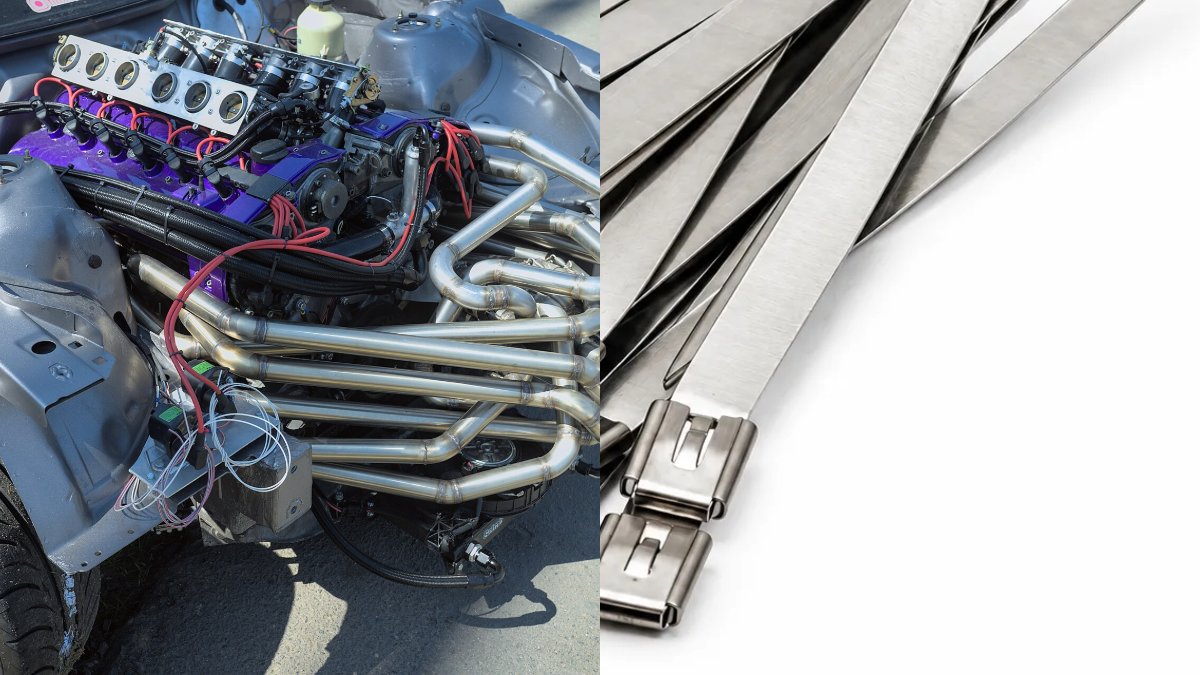
Next to an exhaust, in salt spray or around chemicals, nylon is the wrong material whatever its rating. Use stainless steel zip ties instead. For a job you will undo later, releasable zip ties can be opened and reused.
Common questions
What size zip tie holds 10kg?
Doubling 10kg gives 20kg, so a 4.8mm tie (22kg) is the minimum for a still load. If the load moves or sits outdoors, step up to 7.6mm (55kg).
What size zip tie holds 50kg?
With a double margin you need about 100kg, so the 12.7mm tie (110kg) is the only nylon width that covers it. Better still, spread the weight over several 9mm or 12.7mm ties, and use proper hardware if the load could fall on someone.
Is a longer zip tie stronger?
No. A 4.8mm x 450mm tie has the same 22kg rating as a 4.8mm x 200mm tie. Only width changes strength.
Are black zip ties stronger than white?
No, the same width has the same rating in any colour. Black is the better pick outdoors because our black ties are UV stabilised.
Where do these figures come from?
They are the breaking strengths for our nylon zip ties, as listed on our product pages and packs. For more on what weakens a tie over time, read how strong are zip ties.